Seattle, Indigenous People’s Day 2026, and a Requiem for a Loss
Written By Alex Eklund
Joe Sacco is one of the cartoonists who dragged me back into comics, not gently, but with the kind of force that makes you realize the medium can still do things journalism and prose can’t. His work hits on a deeper, more visceral frequency than anything I’ve ever heard on the news. So when I learned he was coming to Seattle, I did what any reasonable person would do: rearranged my life to be in the room.
Outside Seattle City Hall, I was greeted by a protest or at least the skeletal outline of one. Eight or nine people stood with signs reading “Freedom for Gaza from Hamas,” though the “from Hamas” was printed in such apologetic lowercase that you’d miss it unless you squinted. Seattle has always been a protest city — WTO, Black Lives Matter, and a dozen movements in between — but this was the most pitiful demonstration I’ve seen since Westboro Baptist Church protested my college graduation at Safeco Field. They arrived thirty minutes before the event and left long before it ended, a kind of drive‑thru activism. If they’d actually shown up to take a stand against Hamas, that would’ve been one thing. But anyone who’s been around the block could see the real play: a thin, half‑hearted rally meant to drown out people trying to speak plainly about the atrocities unfolding in Gaza.
Inside the hall, the conversations were a different kind of chaotic: libertarianism, human rights, geopolitical theory, all delivered with the frantic energy of people who have read too many think pieces and not enough books. The median age hovered around forty‑five, which is squarely my demographic, and it made me wonder where the younger people were. This is a book written in the universal language of comics and prose, yet the room was conspicuously devoid of anyone under thirty. Then I remembered: younger readers process the world through One Piece, a comic that explains global inequity with pirates, friendship, and the hope that a band of well‑intentioned misfits can change the world. This conversation, as I suspected, was going to be anything but escapism.
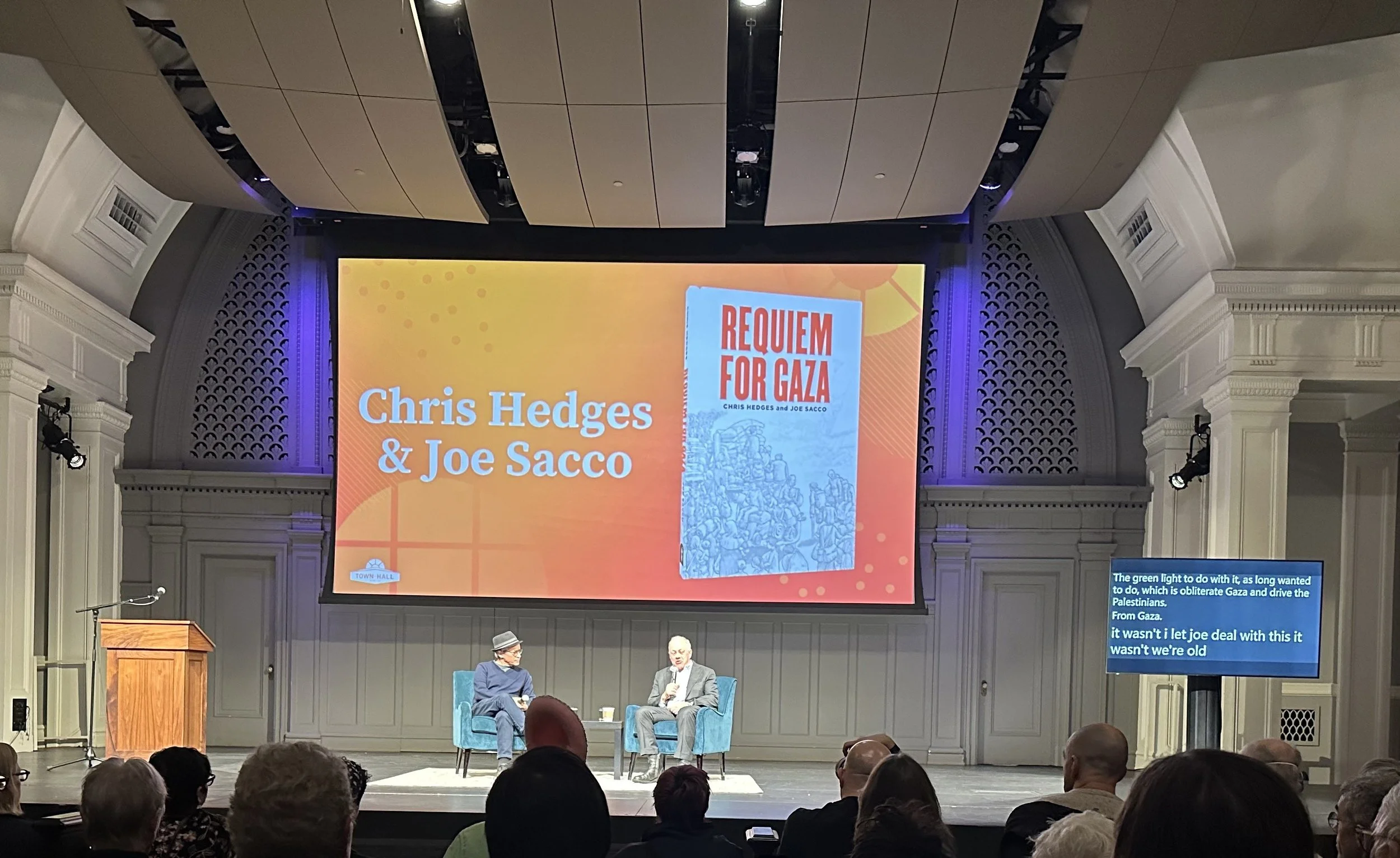
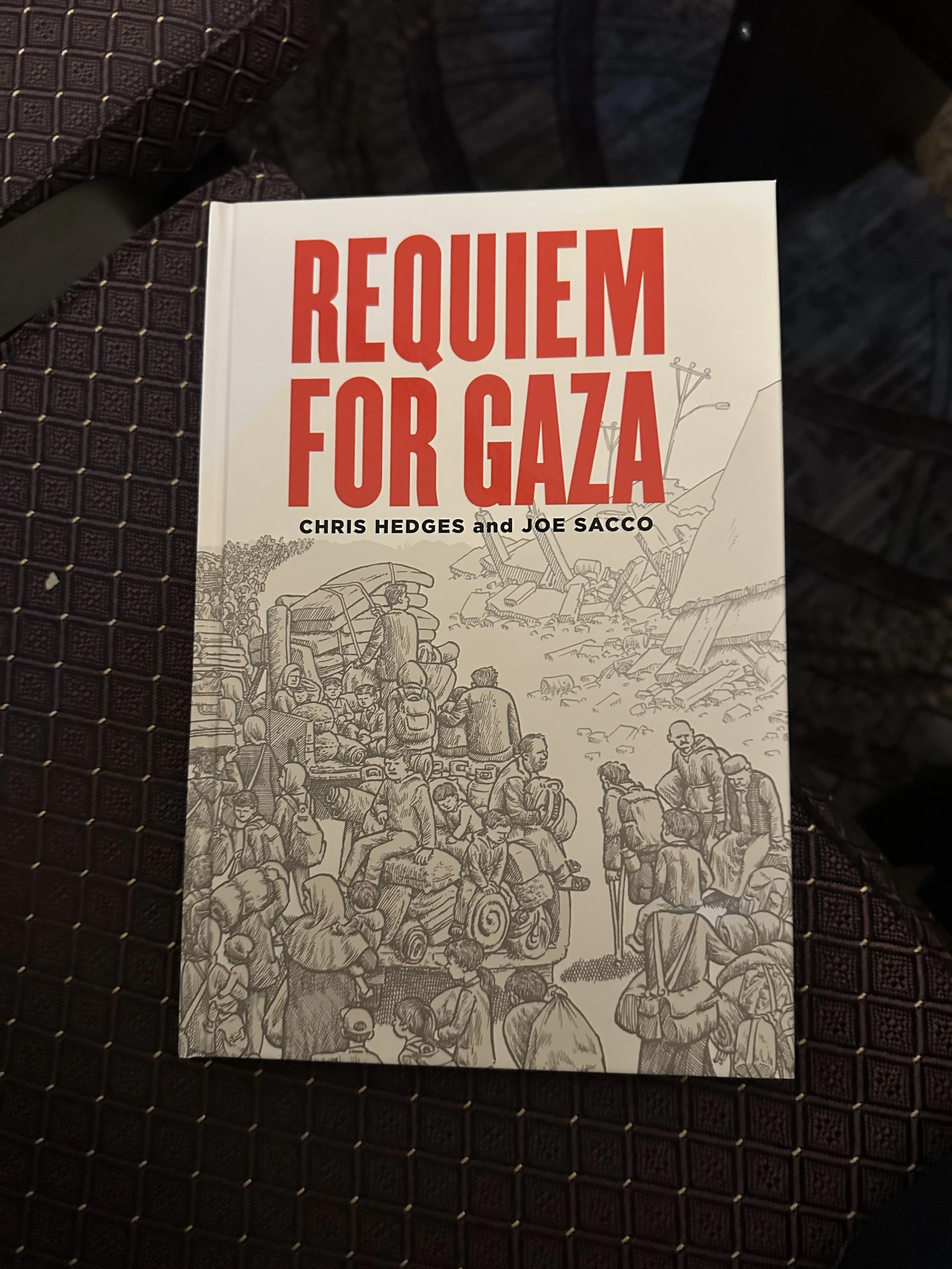
When Chris Hedges and Joe Sacco took the stage, the room shifted. They carried a kind of gravitas you only see in people who have witnessed things they can’t unsee. I recognized the look, I’ve worked in alternative schools where students have been killed, killed others, bragged about horrors, and still somehow found moments of beauty in the wreckage. Sacco and Hedges made it clear that Requiem for Gaza was not a book they wanted to write. It was a book they felt compelled to write out of loyalty, grief, and the unbearable knowledge that the land they cared about was being bombed into nonexistence.
The next ninety minutes were a catalog of horrors I can’t fully recount here. What I can say is that both speakers occasionally sagged under the weight of memory not in embarrassment or annoyance, but in the quiet collapse you see in survivors of trauma. They spoke about the systematic targeting of doctors, the erasure of homes and humanity, the loss of friends and interviewees. It was an evening that will stay with me, quietly stoke my rage, and force me to question the narratives fed to us by national media and American politicians. If Sacco and Hedges come to your community, go. Their honesty is brutal, necessary, and deeply clarifying.
The event took place on Indigenous People’s Day, a fact never mentioned, but impossible to ignore. There was something fitting about discussing Gaza on a day meant to honor the Indigenous people of North America, whose own histories of genocide, displacement, and erasure echo through the centuries. The timing felt auspicious. For one night, Seattle City Hall became a mausoleum — not just for Gaza, but for every community crushed under the machinery of genocide.
Two writers put everything they had into a book that will likely be forgotten by the broader public, but not by me. In my heart, Sacco and Hedges are the Straw Hat Pirates fighting the World Government — and if that reference doesn’t make sense, it might be time to read the most impactful comic about revolution in modern history. Then read Requiem for Gaza, it won’t give you hope but it will open your eyes and that is something we also need now.