Trip to Rose City Comic Con 2026
Written By Alex Eklund
A Brief Field Report from the Northwest’s Most Reliably Unpredictable Show
This was my third trip to Rose City Comic Con, which is quietly becoming one of my favorite Northwest semi-large shows mostly because it still remembers what a comic convention is supposed to feel like. In many ways, RCCC now resembles what Emerald City Comic Con looked like a decade ago, before it discovered brand partnerships and the existential thrill of scheduling panels that never actually occur. (Two panels I attempted at ECCC this year simply evaporated after I waited a polite 30 minutes at each. Rose City, by contrast, managed the radical feat of holding every panel it advertised.)
People like to say Portland is committed to “staying weird.” Rose City Comic Con is the rare convention that seems to take that mandate seriously.
The Good
There were genuine comics moments the kind that remind you why you bother with conventions in the first place. I had a long, unexpectedly delightful conversation with Ed Vick, co‑founder of MU Press, who published early work by Donna Barr and, yes, Ed Brubaker before he became Ed Brubaker. Vick also remains one of the Northwest’s best second‑hand comics dealers, and I walked away with an EC collection that made the trip worthwhile on its own.
I also spoke with Dave Carleson, who worked with Vick back in the day producing early Northwest comics reviews in a newspaper format an artifact of a time when regional comics criticism still felt possible.
Then there was the Dark Horse situation. I spoke several times with a Dark Horse staffer whose name I tragically failed to record and couldn’t look up. They had done an adequate job leading the 40th anniversary panel at ECCC, but at both San Diego and Rose City they seemed to have found a new gear. It was oddly reassuring even after pushing out their founder, Dark Horse appears to have retained at least a few people capable of steering the ship without immediately hitting the rocks.
The Bad
There wasn’t much that was bad, exactly, just a few disappointments that felt emblematic of the current comics ecosystem.
Several creators simply didn’t show up, for reasons unknown. As a fan, it’s frustrating; as a human being, you hope none of the reasons were catastrophic. Though you always get this at a convention but this year felt like more than normal.
More concerning was the noticeable drop in comics creators overall. For a city with as many extraordinary cartoonists as Portland, the absence was hard to ignore. It’s part of a larger trend: the big shows are increasingly dominated by everything except comics, which makes the survival of small‑press and local shows even more essential. If creators are going to meet readers at all, it may have to be at the shows that still remember why they exist.
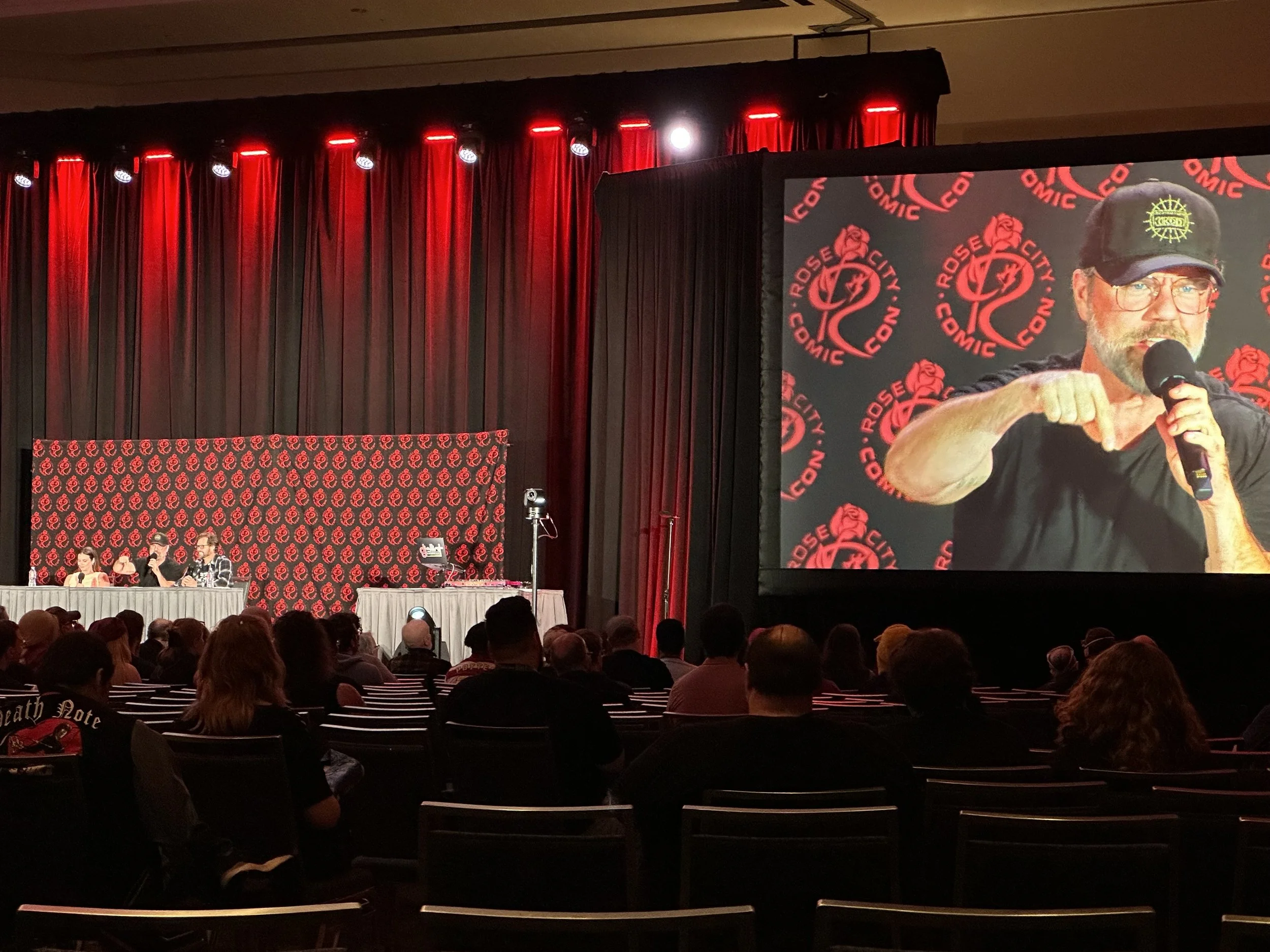
And then there was First Comics. I hate to take a swing at any publisher, comics is a brutal business, but whatever First Comics is doing these days, it isn’t working. Their panel drew a grand total of twelve attendees, and the creators themselves couldn’t be bothered to arrive on time. Once they did, they spent part of the panel disagreeing with Neil Gaiman about the relative importance of story versus character, an odd hill to die on, especially when your own stories aren’t exactly clearing the bar. They later segued into recounting the experience of hitting a deer and speculating about its “story potential,” which was… certainly a choice. The whole panel felt like performance art about how not to run a comics imprint. I laughed, I cried, and then I thought well they might get better again one day.
The Weird
Rose City always delivers at least one moment that feels like a dare from the universe.
On Friday, after driving three hours from Seattle and dropping my bags at the hotel, I walked onto the show floor and was immediately greeted by a full‑sized adult llama. A real one. Not a mascot. Not a plush. A llama. I have no memory of seeing it advertised, but there it was, as if Portland had decided to test my commitment to the “keep Portland weird” narrative.
Moments later, I discovered that Purina had purchased a booth for their Friskies brand, complete with a “super kitty” photo op and a station where you could turn your cat’s photo into a trading card. Naturally, my wife and I made a trading card of our cat. It felt like the only reasonable response.
On Sunday, while wandering the floor for any last‑minute finds, I heard a series of loud crashes. Investigating, I discovered that the convention had installed a full wrestling ring. I watched a match unfold while, roughly 200 feet away, an Elvis impersonator in a cat suit serenaded the crowd. It was a moment so perfectly Portland that it felt scripted.
Conclusion
Portland, please continue whatever civic alchemy allows you to stay weird and, against all reasonable expectations, keep luring me back to Rose City Comic Con. You have a vibe unmatched anywhere on the West Coast, a kind of stubborn regional charisma that makes the whole show feel like it’s operating on its own wavelength. Long may it remain uncorrected.